Meet Yann LeCun's Lab and the AI World of 2030
He’s betting big on predictive architectures. We asked him to play the predictive architect.


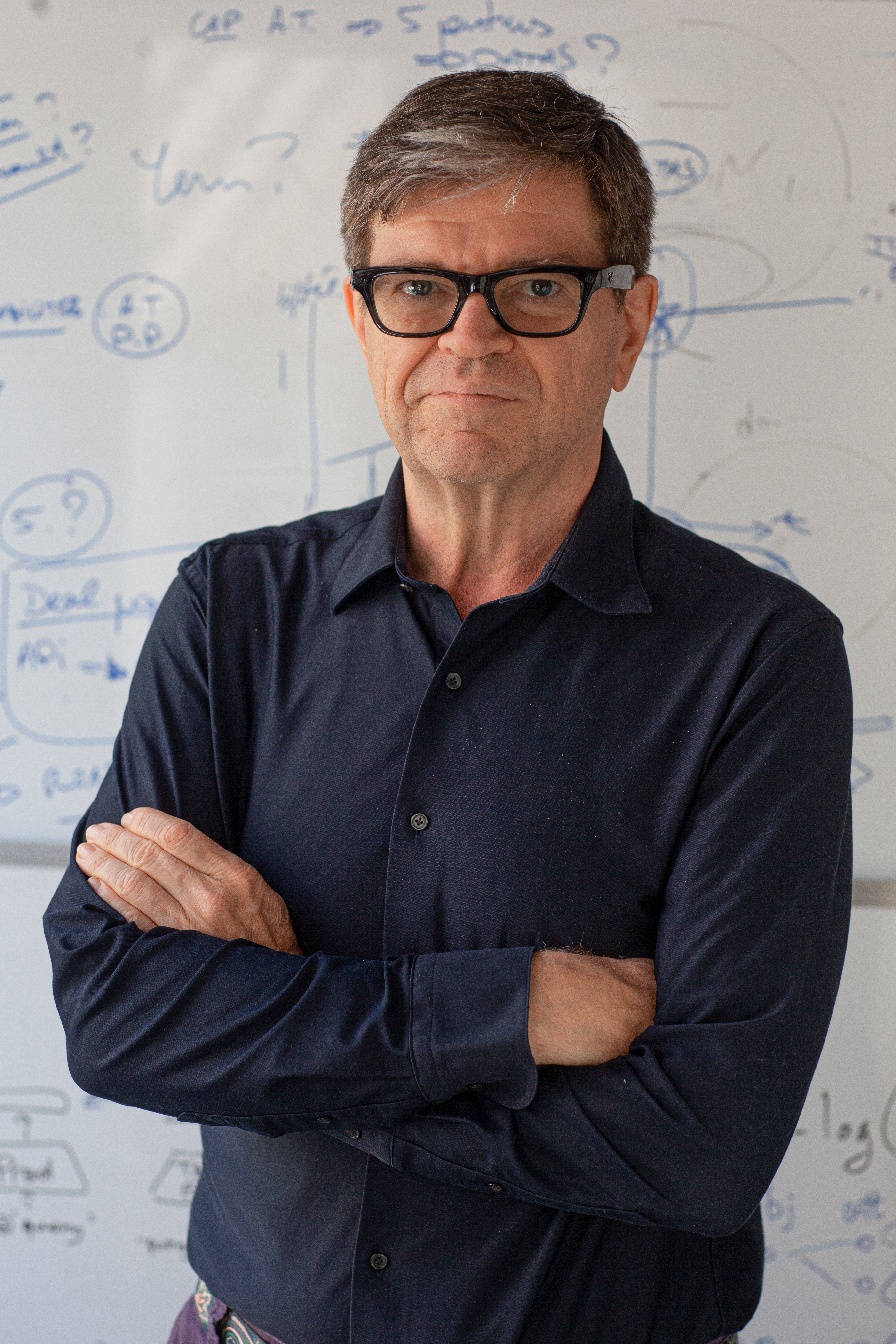
No secrets here, Yann LeCun says as he poses for a photograph next to a scribblings-laden whiteboard in a sunlit, oak-toned kitchen that doubles as his new AI venture’s nerve center. Even if there were secrets, he adds, no outsider could read them anyway.
Since leaving Meta last year, the Turing Award winner and New York University professor has turned his attention to Paris, where he founded AMI Labs among a burgeoning cluster of startups in the chic Sentier district. Here, tucked away between a perfume shop and a prêt-à-porter boutique, AMI, short for Advanced Machine Intelligence, is building what the French-American scientist calls “AI for the real world.”
The markings on the whiteboard hint at what that phrase means: Just above a doodle of what looks like a rose, there’s a double-encoder sketch of a predictive AI scheme. Next to it is a formula for a contrastive loss function that guides a system’s guesses toward correct answers. Nearby is a vector diagram labeled “bottle, open” and “bottle, closed” — his go-to example of what a world model must grasp to predict the outcomes of various actions.
Being able to foresee the consequences of a physical event, like when a bottle is about to tip over and spill, a machine is about to malfunction, or a body is becoming susceptible to disease, could lead to tools with seemingly limitless applications. LeCun says his system will eventually allow robots to handle new and complex tasks on their first try, without millions of training demonstrations. For now, it’s humans who stock the wine fridge in AMI’s kitchen.
Like deep learning in its early days, world models are this season’s teenage sex, LeCun says with a grin: “Everybody claims they’re doing it, but nobody knows what it is.” He’s happy to explain world models, experimental AI systems that are fundamentally different from the LLMs now dominating the industry. And not just because LeCun is a gifted communicator of science, but also because world models are his latest — and perhaps biggest — bet.
That faith prompted him to leave Meta after more than a decade as chief AI scientist. To his mind, the social media giant was just too committed to large language models, something he believes will not, on its own, lead to human-level intelligence. Today, LeCun’s vision sets him against nearly the entire field, which continues to hit milestone after milestone using the very architecture he doubts, while his own remains in the lab. And then there’s the personal toll such commitment entails. The more he works, the less time he has for the pursuits that have fed his creative alter ego for decades, namely baroque and electronic music.
What LeCun sees coming is worth both the risk and the trade: a machine that can plan, reason, and act in the physical world, learning the structure of its behaviour, rather than the surface of how it looks. Backed by $1 billion in investment and an ocean of compute, with Nebius being a key provider, LeCun’s models based on the Joint Embedding Predictive Architecture (JEPA), are starting to produce promising results. A few more months, he says, and AMI will start testing them on practical benchmarks.
His models predict. So does he. LeCun’s world now revolves around forecasts and milestones. Even AMI’s whiteboard boasts one: “Jan. 2027,” circled. So when he sat down for this interview, the conversation naturally unfolded in the future tense. Outside, the first heat wave of the summer was settling over France. Inside the AI world, the news was just as hot.
People often ask you about the future of AI, and most want to know what it will look like in ten years. That’s only natural: someone who spends most of his time developing a Joint Embedding Predictive Architecture is bound to be seen as a predictive architect. But even for you, I imagine ten-year forecasts are asking a bit too much.
Yes.
But three is just fine.
Three to five, yes.
I’d like to ask you to paint a picture of the not-so-distant future — 2030. If 2022 marked the breakout of modern genAI, and today we’re living through the era of massive AI training, what would you call 2030?
AI for the real world.
And the 2022 revolution really happened before, at least for people in the research community. It became a public-facing phenomenon in late 2022. That was a surprise to everyone that the public was so enthusiastic about LLMs. And it made a lot of companies realize that there was a market.
But understanding and producing language is one thing, while understanding and controlling the real world is much more complicated. And we’ve known this in AI for many decades. It’s called the Moravec paradox. Some people in the field are hypnotized by the progress of LLMs and forget about the Moravec paradox, which is still with us.
These systems that do math and write code are super useful. But this is not a path to human intelligence. Not more than neural nets were in the early nineties. I think, in the next four years or so, we’re going to see another revolution that will open the doors to real-world things, not just language. That’s much more challenging. And that’s a revolution I want to see. I’m pretty sure it’s going to happen.
You’ve said that AI systems as smart as a cat or rat would be a real achievement. What is your 2030 estimate? Cat, rat, insect?
Something like that, on the order of a cat or a rat in terms of their understanding of the physical world. We discount how smart animals are because we correlate our impression of intelligence with language manipulation. And that’s just wrong.
Being intelligent includes understanding what happens in the world, how the world is going to evolve, what the consequences of your actions might be, which would allow you to plan a sequence of actions to arrive at a particular goal. And this is something that LLMs can’t do at all.
There’s nothing bad about them. They are useful. It’s just they’re missing major pieces. And that thing we’re missing is world models. Things that can anticipate what will happen in the world and the consequences of an action.
Cat level in 2030, that’s still a bit far from the human level, no?
It’s not. It’s really close.
The question is: what is the underlying technique that will allow a system to run those world models and use them for planning? I think we’ll have a good technique for that within the next few years.
We already have preliminary results that are promising. The big question is, once you have that, how do you make it operational in a robot or a system that controls an industrial process, or a system that learns a model of a complex phenomenon by observation? That’s probably going to be pretty fast.
But then there’s the question of what ingredients you need to build a system that can learn and produce abstractions at the same level as a human. And we don’t know how long that’s going to take. It could be that once we get the basic technique for training world models, it’ll be easy to scale them up and get them to work with more complex concepts.
Or it could be a lot more difficult than we thought. And it may take a decade or more. But there are going to be useful applications of this concept within two to three years.
We’ll come back to world models in a moment. I’d like to ask about the recent government-imposed restrictions on some AI models. Did you see this coming? Do you think it could mark the beginning of a broader crisis for the AI industry over the next few years?
Well, the crisis was already with us. There is a discourse, a safetyist discourse. Of the type, AI is dangerous, and because it’s dangerous, it can’t be put in the hands of everyone. This discourse has been around for a long time in other domains.
There was a similar discourse when the printing press was invented. It gave people access to knowledge, and that was considered dangerous. In the 15th century, for 200 years, the Ottoman Empire banned the use of the printing press for Arabic. And according to some historians, that was actually a major factor in the Ottoman Empire’s decline relative to the West.
Today, AI is a way to disseminate knowledge. The idea that you should limit access to knowledge, intelligence, or education is obscurantism. I’m philosophically opposed to it. I think it’s super dangerous.
If AI is controlled by either a few private companies on the West Coast of the US or China, or by a few governments, like we just saw, it’s horrible. It’s the end of democracy, the end of social liberalism. Your thoughts and all the information you get would be controlled by a few people.
There might be some risks attached to giving access to AI to everyone. But those risks are much, much smaller than the far greater risk of concentrating power and controlling information.
Do you see it evolving into the picture you just described by 2030?
No. I think there is resistance to this. Most countries are probably going to band together to produce open source, open access, open weight, open AI platforms. And in fact, there is also a market push for that because AI is becoming an infrastructure.
That’s what happened to the internet, right? When something is an infrastructure, there’s pressure from the market for it to become open and free because it’s more portable, it’s more secure, and it’s just easier to deploy. So I think the same thing is going to happen for AI; it’s a question of time, and it’s a bit of a question of geopolitical rivalries.
In my opinion, governments aside from the US and China should completely embrace open source. That’s basically their ticket to sovereignty. And it’s weird because the American government, even the current one, is fairly pro-open source; it’s just that the industry is not.
And China actually produces the best open source models right now, which is causing a very strange effect. People are switching to Chinese models because they’re open. So that pressure exists.
Let’s switch to JEPA. How is it different from current models?
The basic idea of JEPA is that we have a complex phenomenon that we observe, not a sequence of discrete tokens, not language, but sensor data from industrial systems, videos, or continuous high-dimensional noisy signals. You cannot use generative AI to understand it. And the reason is that most of that data is unpredictable. There’s noise, and there are highly complex dependencies in it. And if you try to train a system to predict what’s going to happen in a video, there’s no way it can predict every detail. There’s an infinity of plausible continuations for a given video segment.
When you tell people that the way to handle real-world data is not to use generative AI, they have a hard time believing you. But what does that mean? It means that instead of predicting every detail of the signal, you find an abstract representation of the input that allows you to make predictions. If I take a bottle and knock it over, it spills the water. There’s no way you can predict in every detail where the water is going to flow, but you don’t need to. You only need to know it’s going to spill.
You might want to predict roughly in which direction it’s going to fall, what’s going to get wet, and so on. But there’s no way you can predict every detail. The same is true even when you simulate a complex system. Simulators are supposed to capture all the details, but in fact, they don’t.
We never simulate at that level. We abstract away those details and find a representation that allows us to make predictions. So the idea that you need to find abstractions to make predictions is absolutely crucial. And you cannot do this with a generative model. You have to use a JEPA.
There’s a technical difficulty with this. When you train a generative model, you know exactly what to predict because you can observe the continuation of your video or your signal. But with a JEPA, you ask it to predict a representation that the system itself produces. And the problem is that the system can collapse. It can choose to ignore the input and produce a constant representation. So all the complexity of training a JEPA is in the prevention of that collapse.
What do you want JEPA to achieve by 2030? What do you hope it will be capable of?
Some applications are relatively short-term. We’re talking to a bunch of potential industry partners. And they have to do with things like predicting failures or faults in advance.
If you have a good model of how a complex system evolves, maybe you can predict when the system will fail. That’s called predictive maintenance. You can also detect unusual dynamics. If something is broken, you’ll see that the way the system evolves is unusual. That’s called novelty detection. JEPA architectures can do this.
Then there is the issue of control. A JEPA can be turned into a world model. What a world model does is this: given the state of the world at time t, and given an action or intervention you might take, it can predict the state of the system at time t + 1, or a millisecond later, or 10 milliseconds later, or an hour later. In other words, it can predict the consequences of the action you took. If you have such a world model, you can plan a sequence of actions to arrive at a particular state. That’s classical optimal control.
Imagine you have a jet engine, a chemical plant, or a manufacturing line. You observe the entire state of the system through sensors, video, and other measurements. Then you intervene in the system and observe the result. From that data, you train a holistic phenomenological model of the entire system. And once you have it, you can use it to drive the system toward optimized metrics.
For a jet engine, that might mean maximizing longevity or reliability, minimizing CO₂ emissions, or maximizing efficiency. For a manufacturing line, the objectives are different, but the principle is the same. This is the beginning of a new era in optimal control.
These are the practical implementations of JEPA you envision in three years?
Probably before that. We’ll have prototypes within a year or so. We’ll be working with a few partners to see which industrial areas this can be applied to. Some areas will be easy to deploy in, others will be more difficult. We hope there will be a fairly large number of them.
Further down the line, this will probably lead to more general intelligent systems. When you’ll need a system that understands a particular phenomenon and can control it, you’ll simply pre-train it a little, plug it in, and within a short time, it will figure out how to control that system optimally. Eventually, that will lead to intelligent systems for things like domestic robots, self-driving cars, and many other applications.
There’s a big secret in the robotics industry right now. Many companies are building robots, including humanoid robots. None of them knows how to make them smart enough to be generally useful. You can collect enough data to make a robot useful for a particular task. But ultimately, you want a robot to apprehend a new task the first time you ask it—something humans, and many animals, are perfectly capable of doing.
A system trained purely by imitation won’t be able to do that. Every time you want it to perform a new task, you’ll have to collect huge numbers of demonstrations from humans and train the system to imitate them. But if the system can’t anticipate the consequences of its own actions, its capabilities will remain fundamentally limited.
Your 2026 paper, LeWorldModel, shows that this architectural approach can work in practice. What’s the next big challenge?
There are several. One is coming up with a good recipe to prevent the system from collapsing, as I explained earlier. We already have a technique that works very well. We’ve tested it on video at a very large scale. But it has some downsides. It’s based on distillation. You show the full video to one encoder, and a corrupted version of that video to another encoder with the same architecture. The corruption can be partial masking; you can mask the second half of the video or a large chunk of it.
You then run both versions through the two encoders and train the predictor and the encoder to predict the representation of the full video from the partially corrupted one. To prevent collapse, the encoder that sees the full video doesn’t edit its weights by gradient descent. It actually just gets its weights from the other guy.
That’s why it’s called distillation. The output of the first encoder serves as the target for training the predictor and the other encoder. And it doesn’t collapse for some reason that we don’t completely understand. So the theory is still a little flaky, but it works. At least we have one working example of a system that can learn good features. You get very good video representations from that, and you get state-of-the-art performance if you use those representations as input to downstream tasks for action recognition.
That’s great, but we’d like to have a technique that doesn’t use this weird distillation, that uses what we call regularizers to maximize the information content in the representations. We have a few candidates. LeWorldModel uses a technique called SIGReg, which is a very promising one.
It still has a few constraints we’d like to lift. So right now we’re spending a lot of time trying to find the right recipe and measuring it by its performance on downstream tasks. That will require several more months of playing around. That’s what we’re mostly doing at AMI these days.

How do you organize research in AMI?
AMI currently has about fifty people, mostly engineers and scientists.
Right now, there’s a lot of focus on engineering: software, storage, data loaders, data cleaning, and GPU infrastructure. And of course, we’re using Nebius as a major supplier of GPU compute.
And then there is another effort, which is focused on solidifying the methodology to train hierarchical JEPAs and to use them as a world model. Hierarchy is a very fundamental idea. In fact, it’s at the root of deep learning. The reason deep learning is deep. We can only understand the world through hierarchy.
You train the first layer, the system gets the signal from the sensors, and then produces a not very abstract representation that makes very short-term predictions. You predict the next few frames in a video at 10 frames or 15 frames per second. Not a very complicated task. But what you get from this predictive training is a representation of the video that contains what can be predicted in the next frames while eliminating all the details that are just noise. Then, at the next layer, you take the output of the first one and train it to make predictions over a longer term.
And when you train a system to make long-term predictions, it has to eliminate a lot of details, because most details you cannot predict. And the longer term you force the system to make predictions, the more abstract representations you get. This is very important because we understand the world through hierarchy, and machines should do the same. But also because if we can train those hierarchical JEPAs to be world models, it would enable hierarchical planning.
So that’s more research. A lot of it will be published. Much of the research code will be open source. The basic techniques will be out there because we want people to help us. We want them to come up with good ideas around this domain.
I think that would be incredibly presumptuous. A lot of companies believe that they have a monopoly on good ideas, which is why they go secret. We’re not that arrogant. We think that building an intelligent machine is probably one of the biggest scientific and technological challenges of our times. And even within a well-funded startup like ours, we don’t have a monopoly on good ideas.
The proprietary part of what we’re doing is how we apply this to specific industrial applications. That’s where you need stuff you don’t publish: scalable infrastructure, domain expertise, how you make these models sing in particular conditions. That’s where a bit of the moat, if you want, the secret sauce, is downstream from the basic research. The basic research is open.
Do you envision any major changes to the agentic ecosystem over the next three years? Or is it already more or less taking the shape it’s going to have?
No, I think it’s going to look very different within a few years. Mostly because of the lack of world models in current agentic systems. It’s a very bad idea to build an agentic system without it having the ability to predict the consequences of its own actions.
The alternative to that is what current agentic systems are doing, which is applying a recipe. They have no way of predicting the consequences of their actions. And that’s a terrible way to build an agentic system. It works to some extent, but it’s not generalizable. They just apply the recipe blindly. It’s also very expensive to produce because you need to collect a lot of data. So there’s going to be a big revolution in the agentic system over the next few years.
Fully autonomous, level-5 self-driving cars that can operate under all conditions. Possible by 2030?
Yes, entirely possible.
And a home robot that loads my dishwasher without breaking the dishes?
That’ll take a while. And the robot that will do the same job as a plumber and fix the problems in your house, that’s much longer. That’s the last job to be automated. Because that requires a very good understanding of the underlying phenomenon and manipulation. That’s years away, if not decades.
Do you think we’ll soon see AI proposing novel scientific hypotheses from patterns no human would connect?
Clearly, the application of AI to science and technological progress has enormous potential. And there’s a lot of hope and probably not enough investment in the use of AI for things like material science and biomedicine.
Techniques like JEPA would actually be quite useful at some point. What we’re seeing now is that all of the systems that have been successful in science, like AlphaFold, like ESM, which is a group that used to be at Meta, two of them are students of mine — those are all specialized models. They’re not LLMs. They use transformers, they use self-supervised learning. But they’re not LLMs. They’re not trying to predict the next token autoregressively.
The evolution will be that you won’t need extensive model specialization for each domain. Instead, the model will be able to adapt to the domain. If you have enough data, even if it’s completely unlabeled. That could happen within the next few years. That’s certainly the hope behind a lot of these efforts.
What about the AI slope in scientific papers? Hallucinated references, papers being written by AI and accepted to big conferences and serious journals, and then retracted, or not. Is there a risk of the peer-review system collapsing?
Yes and no. The peer-review system is extremely imperfect. I’ve written pamphlets about it and about how to fix it. I wrote one about 15 years ago, when the NIPS conference was discussing how the system could be changed. I made a proposal for how I think peer review should work, which is different from how it works today.
We do need peer review, because we need a way for researchers to comment on papers by their peers, some anonymously, some openly. My proposal was essentially about how to organize that.
Papers should be self-contained entities. Right now, you write a paper for a particular venue, a journal, or a conference, and there’s an exclusive relationship between the two. If the paper is rejected, you submit it somewhere else, and the review process starts from zero, which is ridiculous.
I think there should be an open marketplace, where papers are simply out there. Then people or organizations can choose whether to review them and whether to approve them. I don’t think there should be exclusive relationships. It should all happen in the open.
Now AI slop. Yes, there are bad papers out there. But there have always been terrible papers written by people. To some extent, I think AI is improving the quality of papers. I see nothing wrong with using AI as a tool to write papers. Now, if you use AI and you don’t verify what is written, and you submit the paper, and then the paper is discovered to have a major flaw because you didn’t check, your reputation should go down the tube, at least temporarily.
There’s already a similar phenomenon today. Directors of large labs have their names on many papers coming out of their labs, but they haven’t necessarily read every one of them. Is that okay? It’s not very different.
Ultimately, it’s a question of quality control on the production side. Then we need good filtering on the review side. Most papers are largely ignored, which is what should happen. There’s no reason to prevent access to a paper, which is effectively what traditional peer review does. Every paper should be available.
That’s what arXiv already does. On top of that, there should be community-based evaluation of papers, assisted by AI tools. Then people can use that information to form their own opinion about a paper.
How do you think AI will transform education over the next few years? Do you see any risks in children relying on AI for learning? Could it interfere with the way children naturally learn and develop?
I see an opportunity. I mean, throughout history, when a new communication technology comes in, people say, “Oh, now…” Take the emergence of calculators in the 1970s. Teachers said, “Children aren’t going to do mental arithmetic anymore. They won’t need to because they’ll have calculators.”
That’s true. But calculators are generally kept out of the classroom until children have learned to do arithmetic in their heads. Only then are they allowed to use calculators. Now every child has access to what is essentially a super-calculator—AI. Doesn’t that change the equation?
Yes, but it also shifts what you spend time on when teaching the children.
When I was in the eighth grade in France, there was a national exam. In mathematics, we had to learn vectors, dot products, and stuff like that. But also how to use a slide rule and interpolate logarithms and trigonometric functions from printed tables. You don’t need to do this anymore. It disappeared from the programs. But at the time, these were major things we were testing kids on. AI will have the same effect. It will change what schoolchildren and university students later need to learn.
There’s this idea, disseminated by some people, including in Silicon Valley, that you won’t need to go to college anymore because AI will do everything for you. That’s the most stupid thing I’ve ever heard. It’s exactly the opposite. AI is increasing the demand for more advanced degrees. What happens now is that AI can increasingly take care of implementing things and solving lower-level problems. But you still need people who can ask the right questions, design the right systems, and assign tasks to AI systems.
They are not going to invent a task or a new product; that’s in the hands of humans. Every human is becoming the manager of a team of AI agents. That requires more education, not less. It requires people with vision, people who understand where a field is going, what a market looks like. What we see is an increasing demand for people with PhDs. The coolest job you can have today, and it’s very widely shared, is a researcher in AI. And mostly that requires a PhD.
One of the first partners of AMI Labs is a medical startup, Nabla. What clinical domains do you see mostly transformed by AI in the coming years?
A lot, but it’s going to be very difficult because deploying something in healthcare requires clinical studies and clearance from government agencies. There are already many AI applications in healthcare, mainly not LLMs. Most of them do image understanding. Nabla is more about the administrative tasks that doctors are supposed to do, filling forms, and classifying diagnoses. It’s like a copilot for doctors.
But eventually you’ll see AI being applied more and more to diagnostics, data analysis, and understanding. In imaging, the impact is already big, but it’s going to become enormous. Right now, when you go through an MRI, CT scan, or X-ray, the system needs to generate an image that can be displayed on a flat screen. So that a human could interpret it.
But the original data isn’t a bunch of images. It’s a volume, and our eyes are not really designed to interpret that. An AI system doesn’t need to look at an image. It can work directly with the original data. For an MRI, for example, it’s not an image at first. It’s some spectral domain. You can feed that directly into an AI system without going through the imaging process, which actually degrades the quality of the data.
There’s going to be a lot of progress in this area. At AMI Labs, we’re more focused on the world-model side. Let’s say you have a patient with a chronic disease like diabetes. What course of treatment should you follow to keep that patient’s blood sugar under control? Presumably, the answer is specific for every patient. People have different physiologies, different gut microbiomes, and respond differently to food.
If you had a personalized dynamical model of a patient’s physiology, a world model of that patient, you could use it to plan a course of treatment. Similarly, imagine you have a stem cell from a particular patient. Let’s say the patient has type 1 diabetes, and you want to turn that stem cell into a pancreatic beta cell that produces insulin. What messages should you send to the cell, in the form of different proteins, so that it turns itself into a beta cell? It’s a world-model problem.

What about yourself in 2030? Do you expect your research focus, or the way you spend your time, to be different?
Okay, so I’m turning 66 this month. By 2030, I’ll be 70. I just hope my brain hasn’t turned into béchamel sauce by then. I’m too old to spend time doing things I’m not the best at. That’s why I’m not the CEO of AMI Labs.
I’m the Executive Chairman, but most of what I do is provide scientific direction, inspire people to work on the problems I think are the most promising, and then get my hands dirty on some of the projects. That’s what I was doing during my last few years at Meta. I don’t do management. I’m not very good at it. I see time running out, and I don’t want to do that. Alex LeBrun, who is the CEO, is much better at it.
My goal in life and in my career has been to uncover the mysteries of intelligence. As an engineer, the best way to do that is to build intelligent machines. Ultimately, the goal is to amplify human intelligence and bring those benefits to humanity, which I think is intrinsically good.
So I’d like to make as much progress, or help others make as much progress as possible in that direction. Until recently, the best environment to do this was at FAIR at Meta. Now it’s AMI Labs, because we need to accelerate progress, scale it up, apply it, and it’s better to do this in a startup than in a large company whose interest in those applications is only peripheral.
What are the places you get intellectual input from for AI research?
Neuroscience, cognitive science, and physics. Neuroscience, for obvious reasons. There are questions about the organization of the mind in mammals, birds, and primates. What enables them to learn so fast? As I was saying before, how is it that adolescents can learn to drive in 15 hours? Probably because of a world model. Do we have a world model in our heads? Yes. There’s no question we do, it’s the prefrontal cortex.
There are a lot of other things we don’t understand. We have objective functions that define the tasks we set for ourselves. Some of them are hardwired by evolution. Hunger is an example. It tells you you’re hungry and that you should do something about it, but it doesn’t tell you how. Evolution specifies the objective function, not the behavior to fulfill this objective.
You have to learn that. Most animals learn it by themselves. Humans get help from parents and other members of the species.
So neuroscience has always been a huge source of inspiration for me. Convolutional networks, for example, were inspired by the architecture of the visual cortex. There’s mathematical justification for them as well, but the inspiration came from neuroscience. In the same way, birds inspired airplanes. The details are different, but the underlying principles of flight are similar.
Cognitive science is another source of inspiration. How do children learn their world model? There’s a debate there. A lot is learned simply by observation. I have a colleague at NYU, Karen Adolph, who studies motor learning in infants. She tells me I’m completely wrong—that babies learn mostly by interaction. I disagree. I think we can learn a lot by observation, and we see that in our world models.
Not only is AI inspired by cognitive science, but it also has an effect on cognitive science. That has been the case with deep learning. Now, some of the best models neuroscientists have for understanding how the visual cortex processes images are deep neural networks, particularly transformers. That has been a big contribution of deep learning to neuroscience.
Cognitive science also has the idea of fast learning. Children learn language with way less data than LLMs. I often cite that LLMs are typically pretrained with 10¹⁴ bytes, about 30 trillion tokens, or around 20 trillion words. That’s about 400,000 years’ worth of reading material.
Children learn language by the age of four. The total amount of wake hours in four years is roughly 16,000 hours. Humans are trained on enormous amounts of data, but most of it comes through vision, touch, and audition. Language comes late, and it’s only a tiny fraction of data. Yet we learn incredibly quickly from comparatively little linguistic input. How does that happen?
That’s something I’ve discussed extensively with colleagues in cognitive science, including Emmanuel Dupoux at Meta and people like Alison Gopnik.
Then there’s physics. Why physics? Because the mathematics underlying inference in machine learning is identical to statistical physics, it’s the same mathematics. The concepts are the same: energy, probability distributions, Gibbs distributions.
But it goes beyond that. You can think of a neural network as a physical system. To understand it, you need to understand its dynamics, and the best tools we have for that come from statistical physics.
There’s also the connection with JEPA. I’ve argued that the only way to understand anything is to abstract away unnecessary details so that you can make predictions. That’s fundamental to all of science, especially physics. I could describe everything happening between us right now in terms of quantum field theory. It would be completely impractical because it would predict countless details we simply don’t care about. The right level of description for what goes on between us right now is psychology.
Think about the hierarchy of abstractions. In physics, you have quantum fields, particles, atoms, and molecules. In biology, you have proteins, organelles, cells, organisms, societies, and ecosystems. Every level describes reality by ignoring the details of the levels below. This notion of hierarchical representations is absolutely fundamental. I think it will become so obvious in a few years that people will wonder why we were so blind to it.
Speaking of the future, which science fiction writers have influenced your thinking the most?
Arthur C. Clarke. He’s one of them. The others I find entertaining, but not necessarily describing a believable future, more like asking interesting questions, many of which are more political than scientific.
There is a short story by a French author. He describes a society where everything in people’s houses is gray and bland. Nothing has any kind of character. Everybody wears augmented reality glasses that make the world look great, but in fact, it’s not real.
It’s a French short story. This gadget is called the Oreyeux — ear-eyes in French. Those people are obviously being completely controlled by the government, because they can create whatever reality those people want and make it look nice, even though it’s not. So it’s a predecessor to The Matrix, but less extreme.
It’s interesting. I can’t imagine humanity will ever move to that mode. That’s contrary to human nature. But there is a danger if your AI assistant, using your smart glasses, like the ones I’m wearing right now, comes from a handful of companies on the West Coast of the US or China. Democracy is in big trouble. Culture is in big trouble. Linguistic diversity is in big trouble. Most governments in the world would not accept it. It’s basically like giving away all your TV channels and newspapers to a single foreign entity.
What I find inspiring about Arthur C. Clarke is that a lot of his writing is about what life is about. What is intelligence? Why are we here? What’s the future of humanity? What’s the past of humanity? How did intelligence pop up? You see this in 2001: A Space Odyssey, which is a bit of a concentrate of all the themes that he likes. I find that inspiring.
You consistently publish a contrarian position. What does that cost you, professionally and personally? And is it getting easier or harder to be a dissenter as AI becomes so politically and economically loaded?
Well, I’m not a contrarian just to be a contrarian. I have some ideas about where I think the field will evolve. And if I believe in those ideas, I should talk about them. Now, if those ideas go against the mainstream of the industry, why should I care?
Maybe people won’t listen to me. Some people, when I put something on social media, think I’m an idiot or that I’m ignorant of the progress of AI, which is kind of ironic. But I’ve seen the excitement and the deflation of that excitement for various waves of AI in the past.
People have always underestimated how difficult it is to deploy something in a way that’s reliable enough to be economically useful. That was the case for expert systems. Some applications, of course, had economic value, but it turned out to be much more complex and expensive to build applications by transferring the knowledge of a human expert into rules and facts. So it was only practical for a small number of applications.
Then there was the second wave of neural nets in the late '80s and early '90s. What turned out to be difficult was compute power and access to data. There was only a small number of applications for which enough data was available to make progress. That was basically document understanding, OCR, and, to some extent, speech recognition—although that didn’t become commercially practical until recently. Then there were applications where you could get away with very small neural nets and relatively small amounts of data, like fraud detection, credit card use, and some control problems.
You saw the same thing in the early '60s, when people were working on the Perceptron and ADALINE. Those early models led people to think they were eventually going to build intelligent machines because they had figured out how to train a single-layer system. But by the late '60s it became clear that these techniques couldn’t be extended to multilayer systems.
People kept working on those ideas—they just changed the name of what they were doing. One branch went down the engineering route and became adaptive filters. That had a huge impact on technology. Your cell phone uses adaptive filters, tons of them. They’re the direct descendants of techniques invented in the ‘60s. Another branch became what was then called statistical pattern recognition, which eventually became the foundation of neural nets and machine learning as we know them today.
There’s always this cycle of excitement. “We have this new technique. Ten years from now, the most intelligent entity on the planet will be a machine.” It was false 70 years ago. It’s still false.
Then expectations get renormalized, and those techniques are brought into the engineering toolbox. That’s what’s happening with LLMs today, beyond the hype. We’ll see another wave.
When do you expect these expectations to renormalize?
For LLMs, it’s going to happen within two years. But then there’ll be another wave, perhaps based on world models and maybe JEPA, which will hopefully extend the applicability of AI techniques. Then we’ll develop a lot of things on top of that, and hit other limitations. And we’ll have to wait for another conceptual idea to take us to the next step.
Now, how many such conceptual breakthroughs do we need to reach human-level intelligence? That’s what we don’t know. It’s like climbing a mountain. We can see the mountain in front of us, but we don’t know how many mountains are behind it. We won’t know until we get to the top. And the following ones are probably taller.