Evgeny Sobko explored a trend that was previously treated as a curiosity
Collaborations
Unseen Elegance: Deep Learning and Human Hunch Open Floodgates on New Quantum Frontier
A physicist working from Michael Faraday’s old rooms, armed with intuition, neural networks, and GPUs, has found more solvable quantum models in a year than ever thought possible using any classical method. The trick was human. The pace is still accelerating. Nebius is proud to support this fundamental research by the London Institute for Mathematical Sciences.
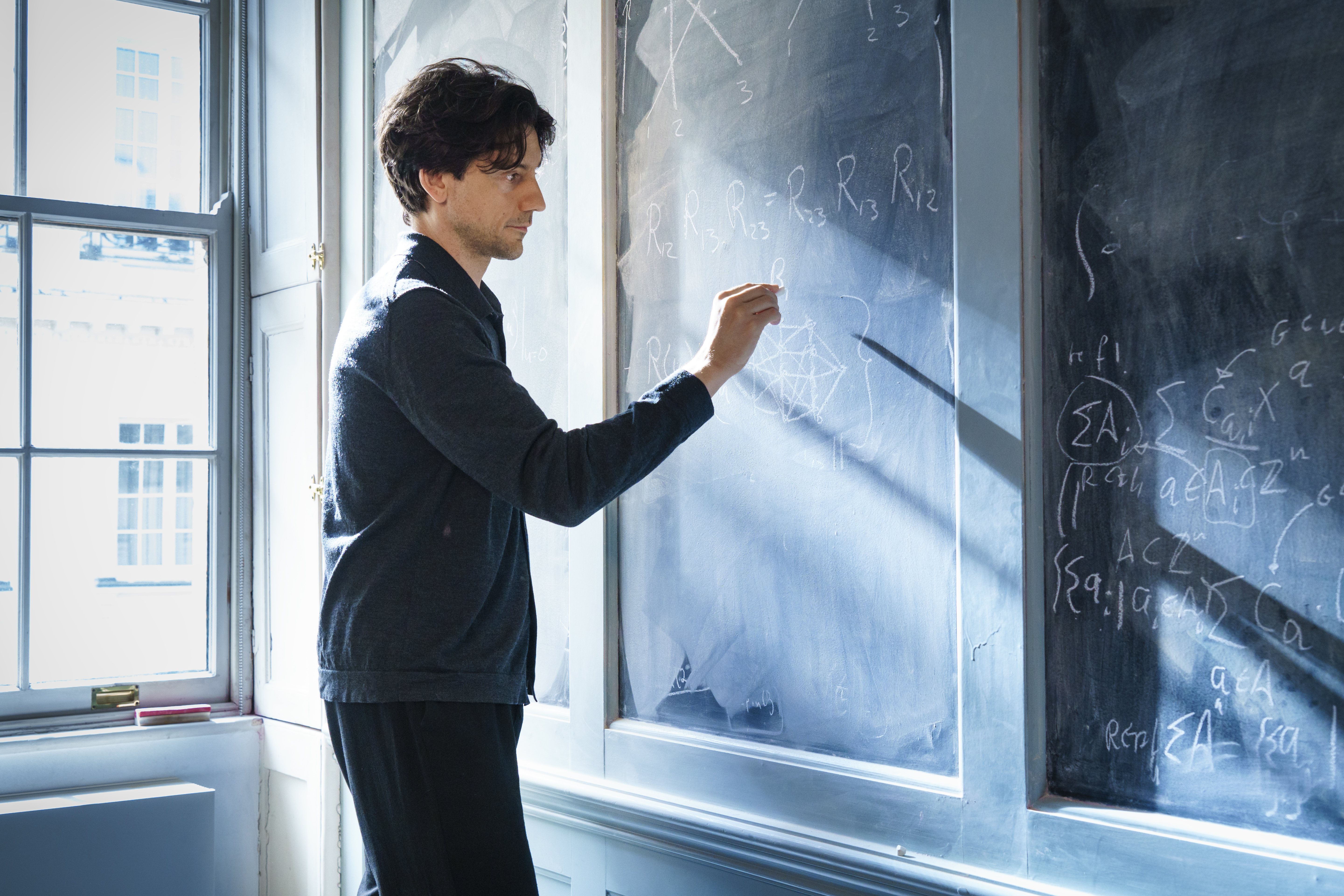

Science often advances when explorers discover a new phenomenon to exploit long before it’s fully understood. Kepler mapped the geometry of the solar system decades before Newton landed on gravity. Mendeleev set the periodic table half a century before Heisenberg and others explained why elements arrange themselves the way they do. And quantum theory itself was quickly adopted even as debate over its ultimate meaning continues — more than 100 years on.
Now, armed with deep learning algorithms and GPU clusters, researchers are compressing the lag from revelation to received knowledge. Some are taking steps that may, one day, help unify fundamental physics and tame the complexity that separates today’s theories from a sole mathematical framework describing all particles and forces; a theory of everything.
Few are forging ahead as quickly as Evgeny Sobko, a prodigy who evolved from mathematician to physicist to both, and his collaborators at the London Institute for Mathematical Sciences, Britain’s only independent institute for physics and maths. Supported by Nebius cloud infrastructure, the minds around LIMS are adding, at a pace no one expected, new points to the small constellation of quantum systems that theorists treat as fixed stars.
These systems aren’t real in the usual sense. They belong to a category known as exactly solvable, or integrable — idealized structures stripped of just enough complexity that perfect answers become possible. They are rare, almost exotic, but indispensable for surveyors of the invisible. From advanced materials to string theory, when a system can be solved exactly, many want to know what it can offer.
Sobko has already found thousands of new systems defined by the Yang-Baxter equation (YBE), an algebraic condition long regarded as one of the central challenges of theoretical physics. Within the class they studied, that’s more YBE solutions in a year than had accumulated since systematic hunts began nearly 50 years ago.
“This is an unexpected and very beautiful result, ” said Konstantin Zarembo, professor of theoretical physics at the Nordic Institute for Theoretical Physics in Stockholm (Nordita) and co-author of a landmark 2003 paper that helped place integrability at the heart of string theory. “People believed that all Yang-Baxter solutions were already known.”
The deepest surprise may not be what is being uncovered or how fast, but how simple the resulting structures turn out to be. Again and again, beneath the staggering intricacy of quantum systems, Sobko’s neural networks converge toward remarkably elegant mathematical solutions. And while AI helped reveal this simplicity, it was Sobko’s intuition that suggested it was there in the first place.
‘It Started Finding Things’
Nearly a century ago, the very foundations of integrability were also laid through human intuition. It was then that Hans Bethe, a future Nobel prize winner and Manhattan Project contributor, wrote down a bold guess for the behavior of a quantum spin chain. And it worked, yielding an exact solution for a system that seemed impossible to crack.
Since then, physicists have used what became known as the Bethe ansatz to tackle different problems united by the same hidden property: integrability. It took until the 1970s to grasp why this method works at all, and even after that, discovering the simplest systems took years of painstaking work. Each result was, in Sobko’s phrase, a small celebration. Now his AI framework generates new ones at a rate that makes the timing of his own celebration difficult.
As of June 2026, uncovering one quantum integrable system takes ten minutes. Recalling the first time he tried the approach, Sobko describes training the simplest type of neural network and launching it on a GPU cluster. “And it started finding things, ” he says in a tone of amazement, via video chat from LIMS, an organization dedicated to research rather than teaching.
LIMS occupies the second floor of the Royal Institution, a science communication organisation founded in Mayfair in 1799, during the reign of King George III. The street out front, Albemarle, soon became the first one-way thoroughfare in London, a result of the horse-drawn carriages that jammed traffic on lecture nights, when Humphry Davy regaled the city’s elite with the latest developments in everything from chemistry to geology.
The building, which houses a 400-seat auditorium, was once home to Michael Faraday, a bookbinder’s apprentice turned experimental scientist who helped usher in the age of electricity. Sobko and his colleagues now conduct research in rooms where the inventor of the electric motor once lived.
“We treat integrable systems as laboratories where many important physical phenomena can be studied, ” Sobko says. “They can be found in quantum mechanics, quantum field theory, statistical physics, strings and so on.”
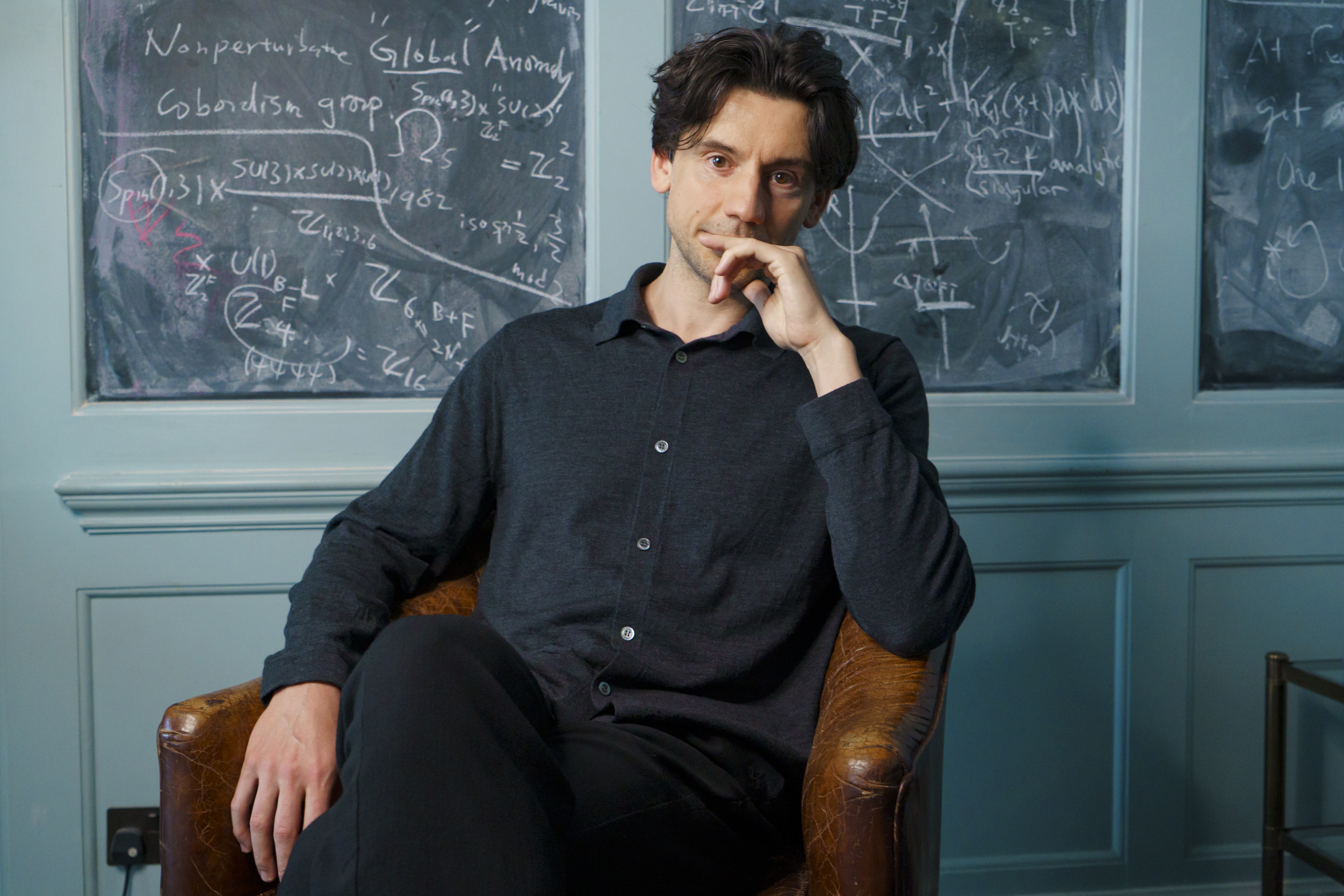
Toy Models
Quantum field theory (QFT) sees the world as full of invisible fields, with particles as discrete — or quantized — ripples of energy. This is a chaotic space where particles collide and change state in infinitely many ways, making direct study impossible in most cases. Integrability researchers look for toy models that allow for the exploration of orderly quantum worlds and someday return with insights into the real universe.
The Bethe ansatz and integrable dynamics only emerge when complicated, many-particle scatterings factorize, meaning they can be broken down into a sequence of independent two-particle collisions. These basic interactions are encoded in the scattering matrix, which describes the most important process in QFT — how particles change after they collide.
The Yang–Baxter equation is the consistency condition behind this factorization. It guarantees that splitting these complex interactions into a sequence of pairwise collisions — regardless of order — produces the same outcome. YBE was systematized and named by the Soviet mathematical physicist Ludvig Faddeev after two scientists who had independently discovered the same equation in entirely different physical contexts.
Storming YBE with computers has its own challenges. First, unknowns in the equations are continuous functions, not fixed parameters. In 1982, Faddeev’s student and collaborator, Nikolai Reshetikhin, proposed an auxiliary system of algebraic equations that serves as a criterion for integrability, now known as the Reshetikhin condition. But this approach made the number of equations explode, a hurdle later overcome with GPU-powered neural networks.
The second challenge comes from the neural network itself. Naturally, simple deep learning models output only approximate numbers. And so does The R-mAtrIx Net, the one Sobko and his colleagues built to solve YBE numerically. It produces large lists of decimals while YBE requires exact results, not floating-point approximations. This is where Sobko’s intuition kicked in.
He recalled a pattern that his predecessors had treated as a curiosity. In already known integrable models, relations between matrix elements involved only integers or simple fractions. Other researchers believed this neatness stemmed from the simplifications used to solve YBE. If they noticed the trend, they didn’t remark on it, and moved on.
Sobko turned this observation into a hypothesis. After generating approximate solutions with the neural network, he looked for coefficients that were extremely close to integers and simply rounded them. “It becomes completely irrelevant what happened in the neural network and what the precisions were, ” Sobko says, “because in the end there’s a verification process.”
Once the rounded values were substituted back into the original equations and verified exactly — no approximation, no AI, just algebra — they either held or they didn’t. And they held, every time.
Even more intriguing, the thousands of solvable models Sobko generated all collapsed into so-called rational varieties, highly structured geometric objects rarely seen in complex systems. “It’s a very exclusive class, quite hard to obtain, ” Sobko says. “I’ve discussed this with algebraic geometers — for them it’s simply shocking.”
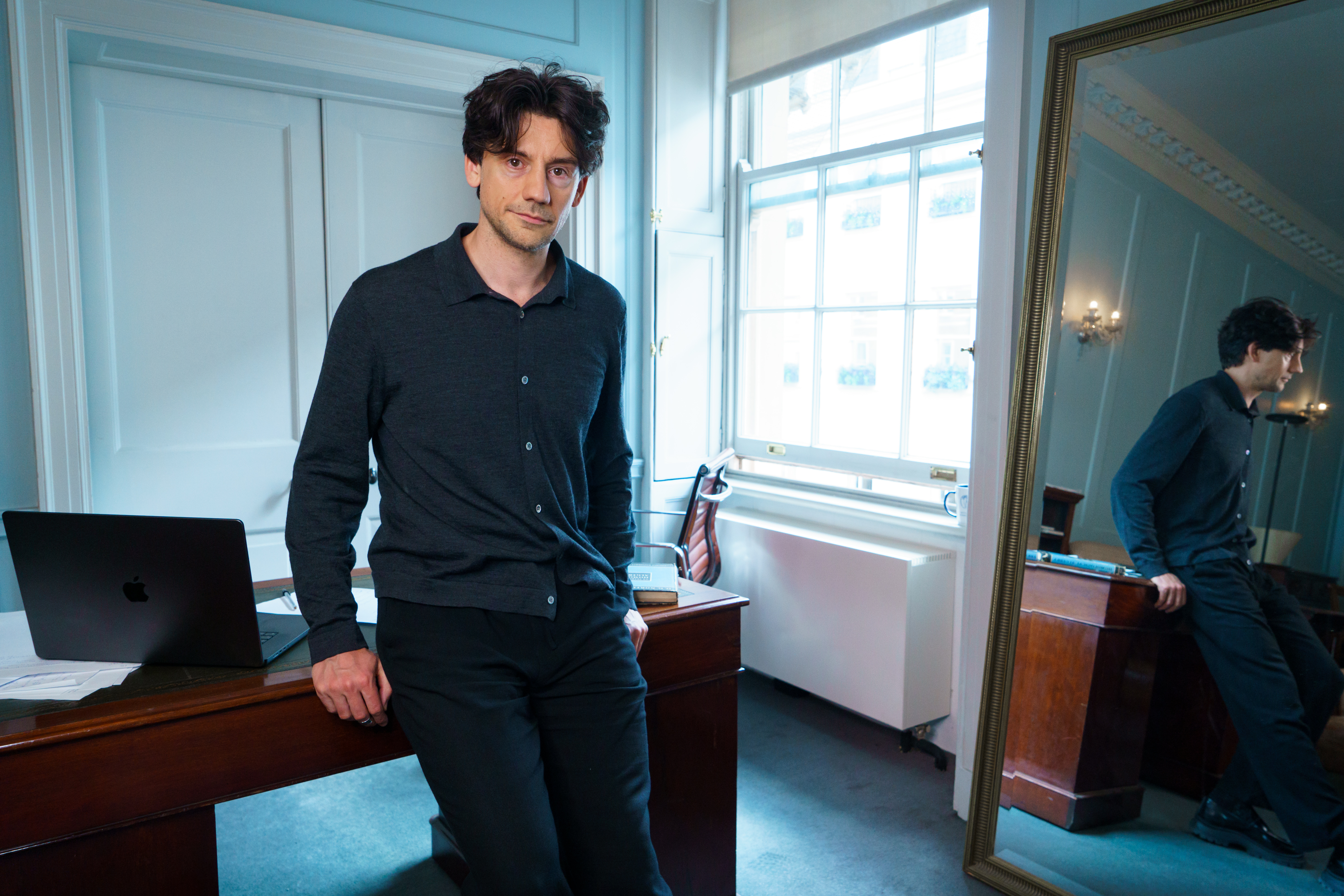
Sobko describes himself as an expert in infinite symmetries
Music of the Spheres
Sobko describes himself as a specialist in systems that possess infinite symmetry — not the handful of transformations that leave a face or snowflake unchanged, but an endless series of them. He offers an analogy that stops the conversation every time he uses it.
Imagine he has an object behind his back and asks you to guess its shape. It could be anything: a toy giraffe, a spinning top, a teapot. Infinitely many possibilities. Then he offers a single clue: the shape looks identical no matter how you rotate it.
“And immediately you know it’s a sphere, ” Sobko says. “One single hint about symmetry collapses infinitely many possibilities to exactly one.”
In integrable systems, the symmetries are not the ordinary rotational kind — finite, exhaustible, visualizable by a child. They are infinite-dimensional: a boundless tower of conservation laws, each one constraining the system a little further, until the dynamics are pinned down completely and exactly. Yang-Baxter is the fingerprint of that structure: the condition whose satisfaction guarantees the tower of symmetries exists, and with it, the exact answer.
This is what “exactly solvable” really means beneath the technical language: not that someone was clever enough to crack a hard problem, but that these systems have so much hidden architecture — so many internal rules that must be obeyed simultaneously — that the solution is forced.
“If you look at these systems from the right angle, you can hear the music of the spheres. You can make sense of them, ” said Zarembo from Nordita, symmetrically arriving at the same metaphor for hidden order.
Early Whiz
Evgeny Sobko’s journey to Faraday’s lab began with childhood math competitions in southern Russia. Identified early as a whiz, he had drawn the attention of Alexander Golovanov, who ran much of Russia’s competitive mathematics circuit.
Golovanov arranged something better than the standard path: admission to School 239 in St. Petersburg, a legendary physics-mathematics lyceum, where 300 entrants in fifth grade get whittled down to 30 by the end of seventh. One of its famous graduates, Grigori Perelman, went on to prove the Poincaré conjecture and turn down both the Fields Medal and a million-dollar Clay Millennium Prize. Sobko gained admission to the lyceum’s tenth grade without taking a single exam. Then summer school reminded him how much he didn’t know.
Sobko left with an overdose of the subject — a common affliction among 239's brightest students, who often find that mathematics, pushed to that intensity, eventually repels. He switched to physics at university. Physics pulled him back anyway, leading to a doctorate in integrable systems at Paris’s École Normale Supérieure, the most prolific producer of Nobel Laureates per alumnus in the world. Before leaving for ENS in 2010, Sobko attended St. Petersburg lectures by Faddeev, Reshetikhin, and Takhtajan — the founding generation of modern integrability studies.
Insights gleaned there helped set the stage for Sobko’s meeting, at LIMS, with Yang-Hui He, a mathematical physicist who pioneered the use of modern AI in string theory and pure maths. Unlike QFT, which describes a universe of point-like particles, string theory replaces them with vibrating, one-dimensional strings, an even more ambitious attempt to explain all forces. Some aspects of this theory deal with exceptionally complex geometric spaces, one of He’s areas of expertise.
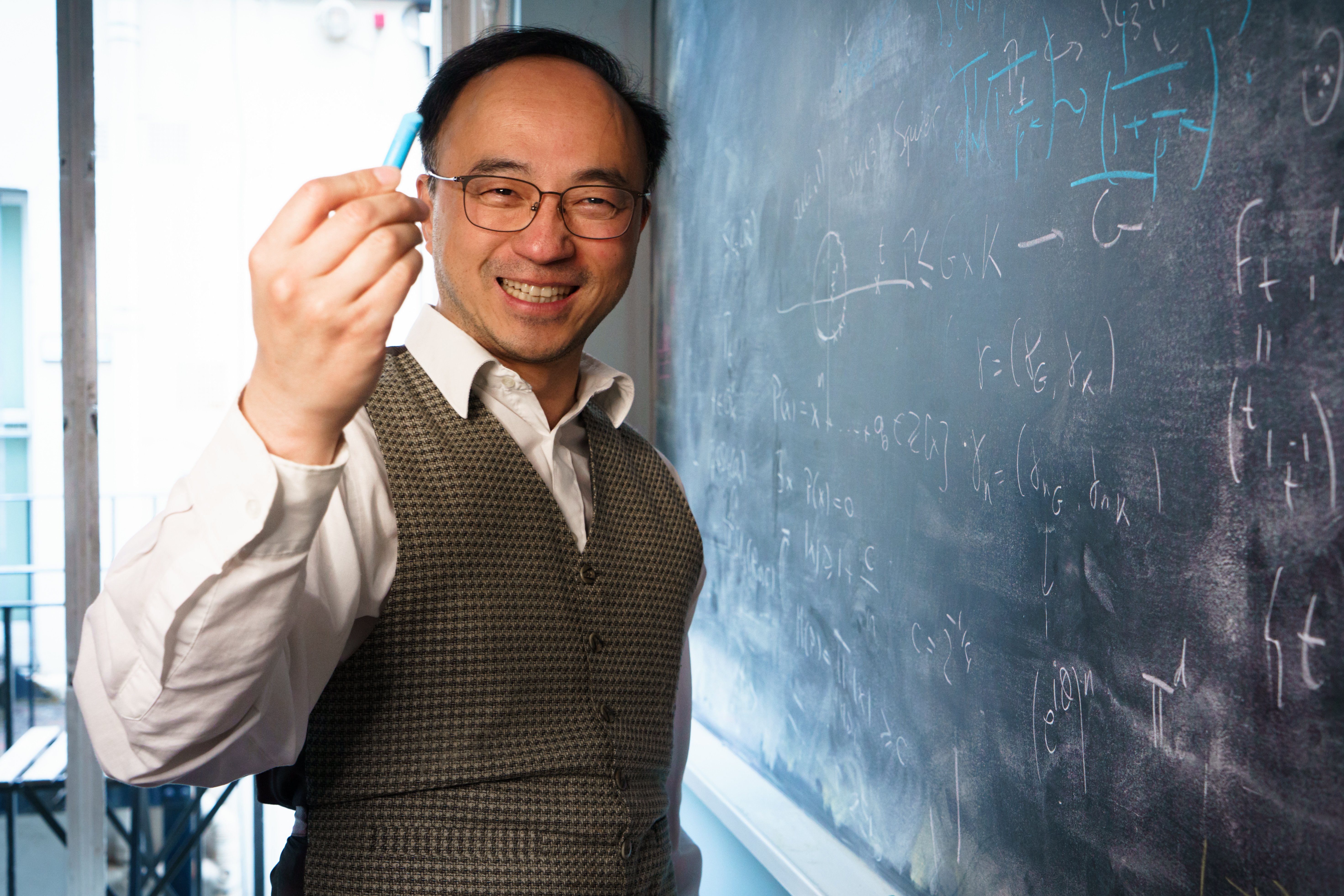
Yang-Hui He pioneered the use of modern AI in string theory
Half-Awake with Calabi-Yau
He’s entry into the machine-learning field happened the way some of the breakthroughs do: in a state of sleep deprivation. It was 2017 and He had recently become a father. The standard months of broken sleep followed. In those hours, half-awake with an infant, he had what he now describes as the obvious idea nobody had thought to try: feeding a database of Calabi-Yau manifolds into a neural network, much like loading cat pictures into an image classifier.
Calabi-Yau are multidimensional structures predicted by string theory and thought to encode some of its physics. Yang-Hui He had catalogued millions of them as long streams of mathematical data. He then translated the catalogue into tensors, vast arrays of numbers treated by neural networks similarly to digital images. Half-convinced it was absurd, driven by something like a somnambulistic impulse, he fed it to a MNIST-based model trained to recognize handwritten digits.
This simple neural network with no training in physics or geometry started predicting numbers that describe the manifold’s structure. The accuracy was 95%, leaving He stunned. The resulting paper, “Deep-Learning the Landscape, ” is now recognized as the opening move on a new chessboard.
By the time Sobko met him, He was already a central figure in AI-driven theoretical physics and maths. He then introduced Sobko to his future co-authors Shailesh Lal and Suvajit Majumder, who were also working on AI and integrability.
These connections proved providential because it’s still rare to find machine-learning aficionados in this field, according to Balázs Pozsgay of Eötvös Loránd University in Budapest. Pozsgay himself is analysing already discovered integrable systems with LLMs and sees his and Sobko’s approaches as so complementary that collaboration could result in a single research pipeline.
“I am happy to be close to the boundary of what is achievable when human and artificial intelligence combine, ” Pozsgay said, adding that AI is being used as little more than ``an extended Google search’’ by most experts in his field. “Those who don’t adapt now will be at a serious disadvantage.”
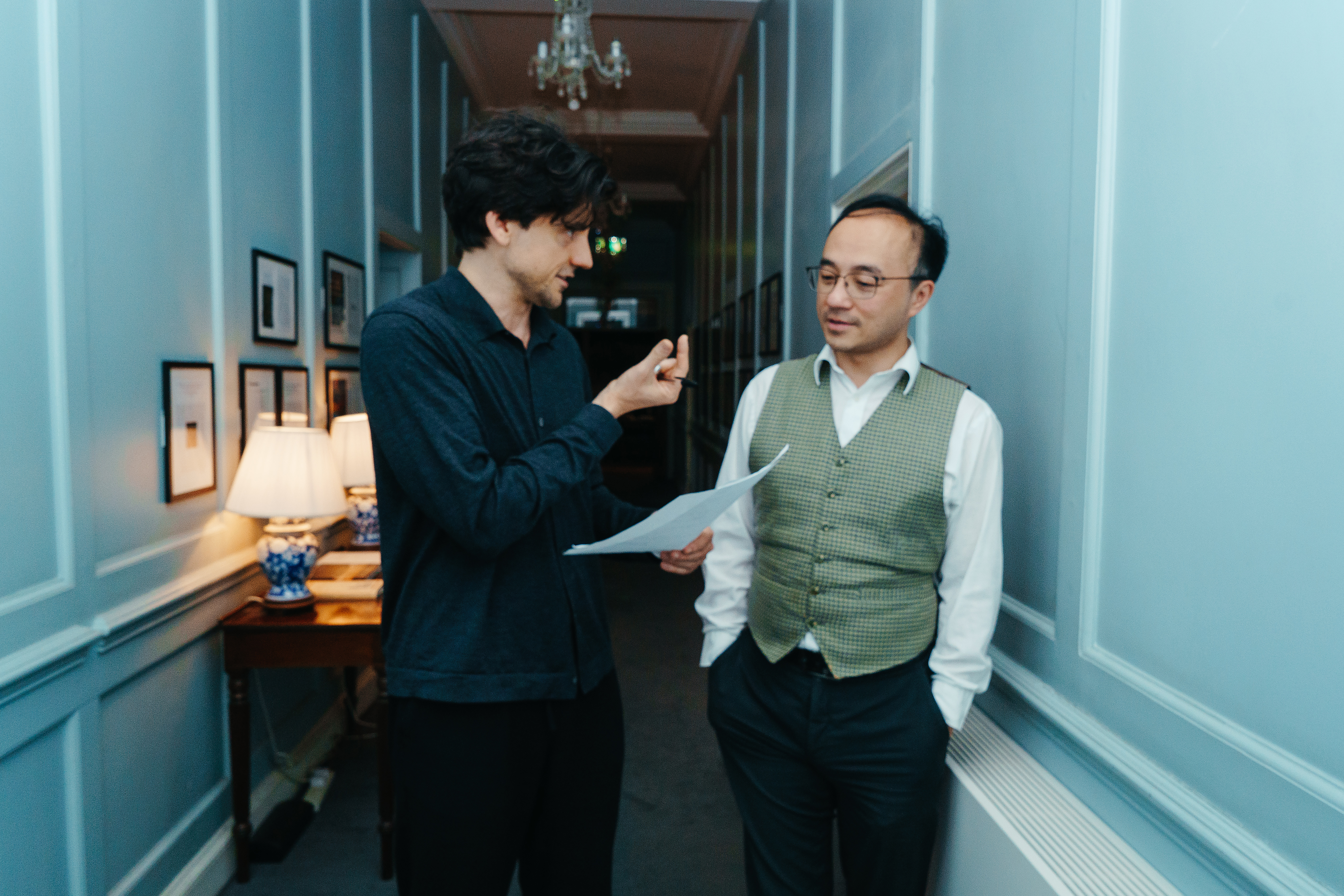
Global Interest
Indeed, as Sobko and his partners are showing, the interplay between real and artificial neurons can produce insights about the natural world at a pace once thought impossible. Now, everyone in the orbit of theoretical physics, even the old-schoolers who built the intellectual scaffolding Sobko is now climbing, are paying close attention.
Nikolai Reshetikhin, one of Faddeev’s key collaborators in what was then called Leningrad, and who’s now a professor at Tsinghua University, is aware of the results and finds them quite surprising, Sobko says. Vladimir Korepin — another of the field’s founding figures who now leads quantum physics at Stony Brook — has sent Sobko specific model classes to search. Some of his interests are practical: Yang-Baxter solutions can function as universal quantum gates, the basic logical operations of a quantum computer.
The requests arrive from elsewhere, too. String theorists have suggested classes of models motivated by the celebrated duality between a four-dimensional gauge theory and a ten-dimensional string theory — an AdS/CFT correspondence, discovered by Juan Maldacena in 1997, that reshaped how physicists think about quantum gravity. This duality turns out, in a certain limit, to be governed by the integrable structures Sobko studies.
Topologists working on knot invariants are excited too: there is a YBE-based method for generating invariants, and now they have a powerful pipeline for producing solutions by the thousands. Researchers in open quantum systems — physical setups that interact with their environments — have sent configurations relevant to problems where integrability has barely been explored.
“We get requests from very different parts of physics, ” Sobko says.”Things they can’t find, but maybe we can.”
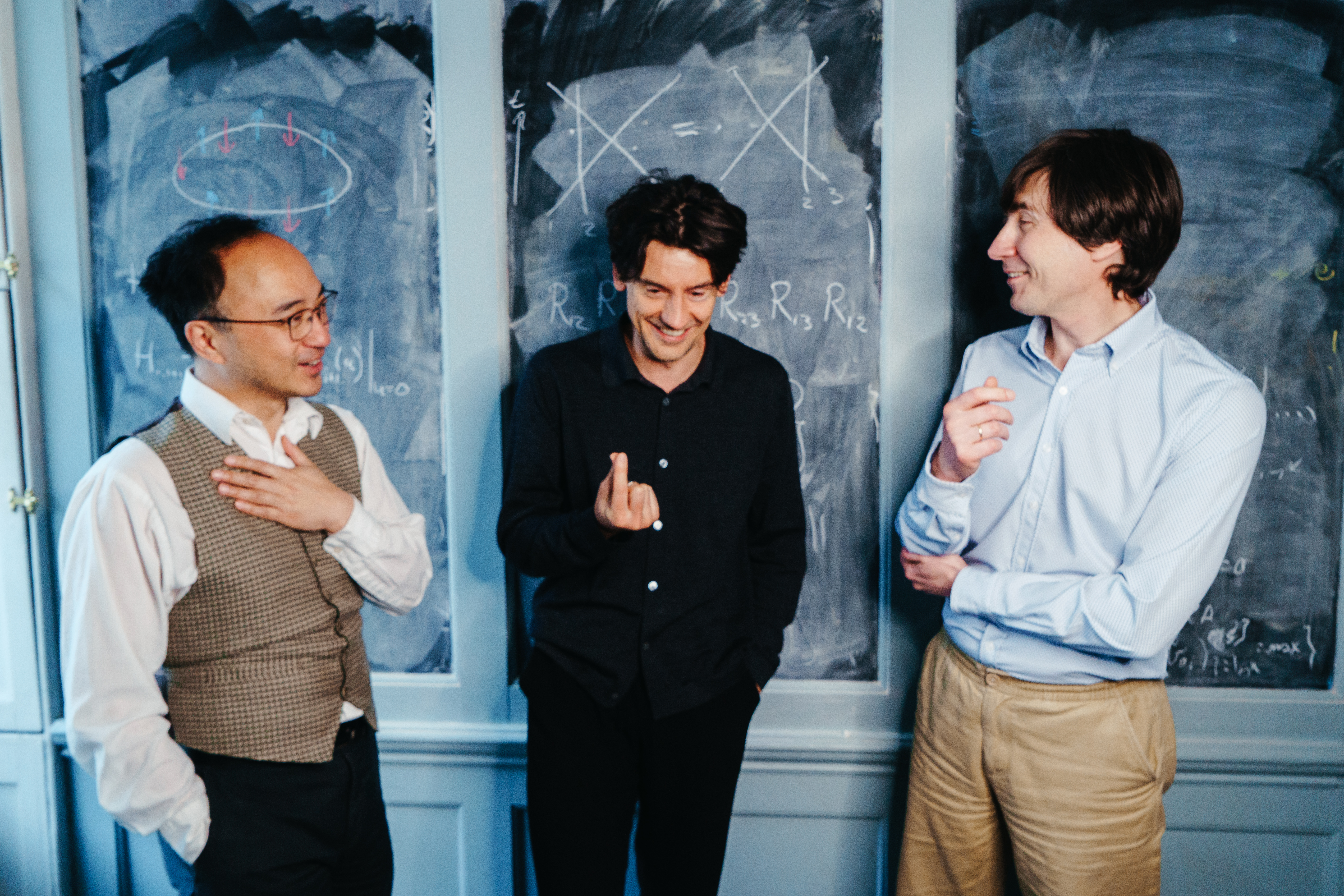
Yang-Hui He, Evgeny Sobko, and Mikhail Burtsev, Landau AI Fellow at LIMS
One Ten-Tredecillionth of a Second After the Big Bang
The quantitative shift — thousands of new models in roughly a year, against long stretches of slow accumulation — is striking enough on its own. The shift in what physicists can now investigate may prove more consequential.
Exactly solvable models were long assumed to be isolated: exceptional objects scattered sparsely through a mathematical wilderness, each found through a combination of ingenuity and luck. Scarcity was part of their mystique.
AI’s output now suggests something different. The new solutions are densely clustered. Finding one often yields 10: small perturbations of a known answer generate new ones nearby, as if they’re neighborhoods rather than isolated outposts.
Sobko and his partners are automating the full pipeline — removing the last stages that still required human input. If enough are found, analytical tools that He developed for the string landscape become applicable: machine learning turned inward, tasked not with finding new solutions but with understanding the structure of the ones already found. Big data, applied to a catalog that barely existed a year ago.
The direct path to string theory’s most important applications remains, for now, a step or more away. The solutions Sobko has found so far belong to a class where the governing mathematical object has a particular simplifying structure. The version controlling strings in the Maldacena duality does not. Extending the framework to cover that harder case is one of his next targets — and if it works, string theorists will have, for the first time, an engine for producing exact results in terrain where existing tools have been losing ground.
“Half a century ago, any question you could ask already had an answer in principle — as long as you weren’t asking questions like 'what’s inside a black hole' or 'what happened at 10⁻⁴³ seconds after the Big Bang’, ” Sobko says. “But such questions also need to be asked, because that’s what a Theory of Everything is supposed to cover.”
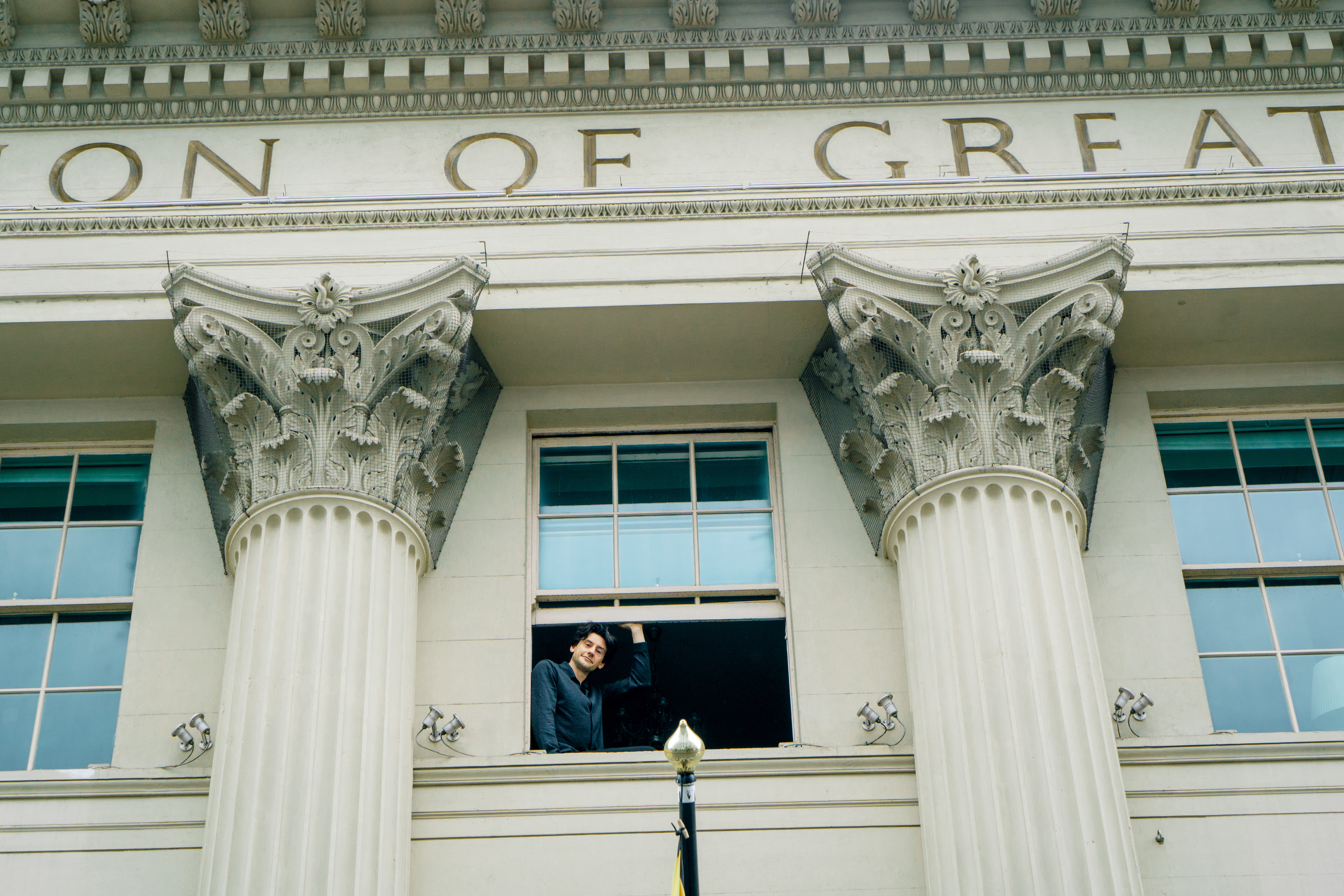
Rooms where Michael Faraday lived are now home to LIMS
Feynman’s Blackboard
Among those interested in resolving the mysteries of integrability was last century’s great explainer of the universe, Richard Feynman. Notoriously unorthodox and famously forward-thinking, the Nobel laureate and accomplished bongo player left behind a blackboard’s worth of notes after his death in 1988.
This final snapshot of his mind combined the guiding principles of his life in science with a short list of topics worth investigating. First on that list was the Bethe ansatz, the 1931 insight whose modern explanation runs through Yang-Baxter. Foremost among the principles: “What I cannot create, I do not understand.”
Sobko, Lal, and Majumder have made their neural networks learn the mathematical world that grew out of the ansatz and have produced volumes of viable results from that foundation. But they haven’t created them in the Feynman sense, and the patterns the team has discovered — the prevalence of integers and the rational structure of the solutions — have yet to be explained.
For them, what matters now is what comes next.
“We’ll generate not hundreds or thousands, but hundreds of thousands of these models, ” Sobko says.
At that scale, entirely new questions become possible — not just finding exactly solvable worlds, but mapping the geography of the territory, understanding why it’s so much more populated than anyone believed.
In this, LIMS researchers stand in familiar company. Kepler had no theory of gravity. Mendeleev had no quantum mechanics. Bethe had no integrability. They found the pattern and trusted the explanation would follow.
Often enough, it does.
See also

Sign in to save this post