Field Reports

Mathematics 2030: A Field in Search of Itself

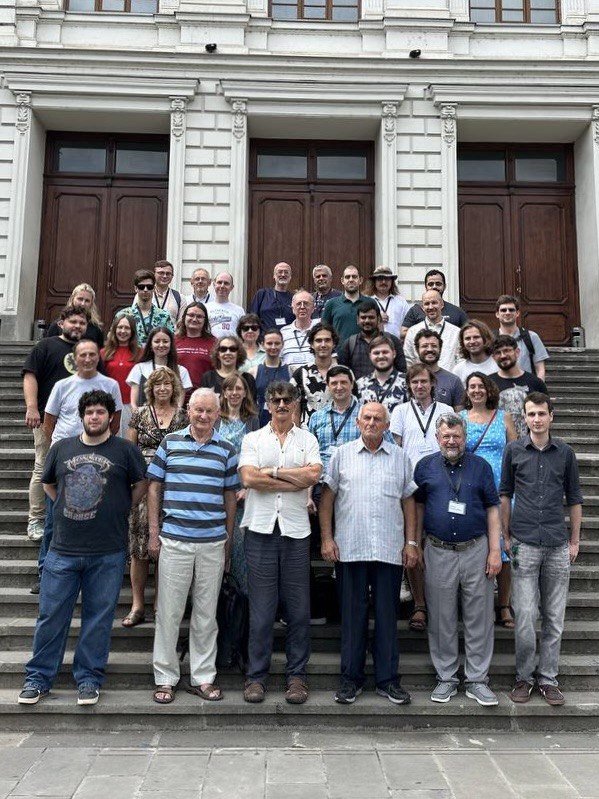
At a Tbilisi conference co-organized by Stevens, Bar-Ilan, and Nebius Academy, algebraists explored how AI might reshape mathematics. They produced a portrait of a field renegotiating its identity with the machine.

Open problems in mathematics now come in three kinds. Easy: one click on ChatGPT Pro. Medium: a short, straightforward dialogue with an LLM. Hard: none of the above.

That was the taxonomy Alexei Miasnikov of Stevens Institute of Technology proposed late last month at an algebra conference in Tbilisi. Co-organized by Stevens, Bar-Ilan University and Nebius Academy, the gathering brought together mathematicians who, in between Chevalley groups and Jordan superalgebras, devoted a day to AI and forecasting their own future.

Mathematics may be entering both its most fertile era and its sharpest existential crisis. The latest signals are startling: an AI system formalised Fermat’s Last Theorem in days, while another generated a contested proof addressing Navier–Stokes—one of the field’s great open problems.

Ten thousand AI agents may solve a hard problem without helping humans understand the proof. And as machines become capable of more research tasks, curiosity and excitement arrive alongside a disquieting question: what is the role of human mathematicians? The discussions at Tbilisi State University kept returning to it through practical questions about how to organise research, recognise valuable work and train the next generation.

Clearing the List

Miasnikov has spent a career on the hard kind of problems, and his talk concerned what to do with the other two. “Easy problems are currently giving us a huge problem, ” he says. Many of them aren’t open because nobody bothered: closing them takes careful case analysis or a counterexample search, not a new idea. Solving them might be automated, allowing the mathematical community to focus only on the hard problems that can lead to new insights.

When an answer becomes cheap to obtain, mathematicians must decide how to record it and what deserves a conventional paper. LLMs now knock these out in bulk, and each solution is technically a paper. However, nobody wants to write an arXiv article about a triviality, so the results go nowhere while the problem lists stay stale and people keep spending time on questions that no longer deserve it. New kinds of resources are needed to share these small but still potentially valuable results that might later help someone in their research.

This is part of a programme at the joint Stevens, Nebius and Gradarius laboratory for AI in mathematics. Its ambitions include a specialised mathematical model. Miasnikov’s proposed division of labour would let agents clear routine problems. A separate strand of the lab’s research combines specialised algorithms and machine learning to tackle longstanding open problems.
Mariia Matveeva from Stevens presented one such effort. Their team is investigating whether a particular Burnside group, B (2,5), is finite. Their computational target involves simplifying 119 symbolic expressions, some tens of thousands of symbols long. They combine rewriting algorithms, share useful rules between them and use reinforcement learning to select approaches.

Here, the team is using a research environment in which agents propose ideas, consult literature, run experiments and check arguments against a shared record. Separate agents challenge results, while humans direct the work and arbitrate disagreements. Failed approaches become part of the record, helping prevent repeated mistakes. The broader ambition is a system that accumulates data across attempts, and grows knowledge of why an attractive idea fails.

ABOUT THE CONFERENCE

Geometry and Model Theory of Groups and Rings IV took place at Ivane Javakhishvili Tbilisi State University on 24–29 August 2026. The fourth in a series held in Georgia since 2023, it brought together dozens of researchers including Alexei Miasnikov, Elena Bunina, Olga Kharlampovich, Ivan Shestakov and Efim Zelmanov, the 1994 Fields Medallist who solved the restricted Burnside problem.

The programme covered algebraic geometry, equations in groups and algebras, model theory and related topics. A full day was devoted to AI in mathematical research, alongside two afternoon discussions exploring the future of mathematics and mathematical education.

The conference was dedicated to Eugene Plotkin (1955–2026), a leading Bar-Ilan University algebraist. He was known for his work on Chevalley groups, connecting the study of algebraic structures with geometry and mathematical logic.

Four Roles

Nebius' Head of Science and Education Elena Bunina, explored AI’s impact from the community’s perspective in her talk, “Mathematics 2030”. The field is about more than proving theorems, Bunina, a mathematics professor at Bar-Ilan University, says. It’s also about choosing research directions, formulating conjectures, finding proofs, validating them, explaining and teaching them. AI already helps with the middle of that list. That exposes the bottleneck at the end: getting new results understood and used.

A correct proof nobody can absorb or connect to their own work has limited reach. Even a flood of verified results, Bunina argues, leaves the community struggling to organise them into coherent theory. She sketched four roles for the mathematician of the future. Deep experts choose the important problems and judge machine output. Research leaders organise people, AI systems and formal tools around long projects. Explainers make new results intelligible to the field. Teachers bring in the next generation. “Broad roles, not fixed professions, ” her slide said. One person may hold several.

Some institutional questions followed. What should departments teach and reward? Bunina’s list: deep expertise, critical thinking, communication, mathematical taste, and fluency with AI and formal tools: “One can only study with AI what they understand.”

Future Supply of Researchers

Vlad Stepanov of the Stevens-Nebius-Gradarius lab brought these questions closer to the classroom with a survey of conference participants. More a portrait than a poll, the small study nevertheless caught the community’s mood. One finding captured the tension: most respondents rated AI’s effect on their own careers more positively than its effect on today’s undergraduates.

The worry was about how expertise develops. An established mathematician can assess a proposed solution against years of accumulated understanding. A student may receive the solution before acquiring the ability to produce or question it. As one respondent put it: “Don’t assume that reading, or even understanding, a solution develops the skill of solving.” The failed attempts that AI can spare a learner may be exactly what the learner needs.

On some points the group was nearly unanimous. AI-generated results will be trusted within three years. Mathematicians will still need to understand the ideas behind those results even once they are formally verified. The explainer becomes a central role. And teaching has to change now.

Past that, the room split. Will AI create new, meaningful theories within three years? Will future mathematicians need less detailed understanding? Will Lean help the community cope with the flood of results? Should first-year students do research with LLMs? On each, opinion divided, and on the most basic question of all, whether mathematicians will still be proving theorems themselves in three years, the largest group simply did not know.

The participants were mostly aligned on what a new classroom should look like. Homework drew particular doubt as evidence of independent understanding. Oral examinations and interactive assessment, where students must explain their reasoning, were the favoured replacements, but they bring problems of scale and consistency while swapping an easily automated assignment for a meaningful test of understanding creates new work for teachers.

Stepanov’s own position was to teach students to work with AI from the first year while preserving productive struggle: learning when to seek help, and being precise about what one still does not understand.

The stakes reach beyond examinations. Every mathematician in the room learned to think by doing the steps that AI now offers to do for their students. If those steps are routinely delegated, universities will have to find another way to grow the judgment that lets a mathematician supervise a machine at all.
Sign in to save this post